May 27, 2026 | 9 Min Read
API-First Was a Nice-to-Have. The Agent Era Makes It Table Stakes.
What a CTO at a 50K-SKU aftermarket retailer told us last month: “Our current platform’s integration list is the platform’s customer list. Anyone we want to connect that’s not on it requires a ‘partnership conversation’ that takes six months. We don’t have six months. Our AI agent connector needed to ship last quarter.”
For most of the last decade, “API-first” was a nice differentiator on a vendor’s feature page. Operators who valued it bought platforms that had it. Operators who did not value it bought platforms with bigger app stores instead. Both choices were defensible. The market did not punish either decision.
That ended in February. The arrival of AI agents as a real acquisition channel changes which architectural choice survives.
If an AI sends a buyer to a store the agent cannot transact with end-to-end, the recommendation reverses. The AI learns.
Why agents need APIs, not partnerships
An AI agent acting on behalf of a buyer does not have time for a partnership conversation. It does not have legal standing to negotiate a data-sharing agreement. It does not have an account manager. What it has is a query, a buyer’s intent, and a few hundred milliseconds to find a store that can satisfy both.
That means the integration story for the agent era is structurally different from the integration story of the last decade:
- Last decade: Integrations were built by humans, between named vendors, over weeks or months of paperwork and engineering. The platform’s app store was the integration surface.
- This decade: Integrations are read and written by agents, against open APIs, in seconds. The platform’s API surface is the integration surface.
An agent that wants to complete a purchase needs to (1) read the product catalog including fitment relationships, (2) query inventory and pricing, (3) construct a cart, (4) submit a payment intent, and (5) confirm the order. Each of those steps either has an API endpoint the agent can call, or it does not. If any one step requires a browser session, a JavaScript event, or a “partnership conversation,” the agent fails. Agent-assisted buying readiness is the operational name for getting all five steps API-callable.
What “open” actually means in 2026
“Open architecture” is the kind of phrase every vendor claims. The honest definition has three tests that apply specifically to whether an AI agent can transact with the platform.
Queryable catalog data. Product information, fitment relationships, attribute schemas, kit definitions, and inventory have to be exposed as structured data through an API endpoint the agent can call without a browser. ACES and PIES data has to be available as queryable graph relationships, not rendered into product description text. The qualifier prompts that determine fitment have to be machine-readable inputs, not HTML form fields.
Stateful cart as an API resource. The cart cannot be a browser-session object stitched together with cookies and JavaScript. It has to be a stateful resource with a clean lifecycle: create, modify, query, complete. An agent has to be able to add a SKU, validate fitment against the customer’s vehicle, change quantities, and submit the cart for payment: all through programmatic calls.
Programmatic checkout. The payment flow cannot rely on browser redirects to external tabs, third-party authentication popups, or human-readable “I agree to terms” checkboxes. An agent acting on behalf of a buyer has to be able to authenticate the transaction and complete the purchase through an API call that returns a confirmation, not a redirect.
Platforms that satisfy all three tests look very different from platforms that satisfy one or two. Most ecommerce stacks satisfy zero.
The closed-platform problem
Closed platforms were not built badly. They were built for a different acquisition channel. When customers arrived through human-mediated paths (search engines, social, email, direct) a platform’s job was to render a great human experience. The optimizations that win in that world are conversion-rate optimization, theme polish, marketing automation, and app ecosystems. Closed integration models worked because integrations were rare events between known parties.
The AI agent era inverts the assumption. Integrations are constant events between unknown parties. The “unknown party” is whichever LLM or agent framework the buyer happens to be using on a given day, and the integration is happening in real time as the buyer composes a query.
On a closed platform, the agent’s options are limited:
- Find an existing app in the platform’s app store that exposes some subset of the data the agent needs. Most agents will not.
- Wait for the platform vendor to ship an “AI partnership” with a specific LLM provider. Most platforms have not.
- Scrape the storefront and try to simulate browser behavior. Most agents are not allowed to.
- Skip the store and recommend a competitor whose API surface is open. Most agents will.
That last option is the one that compounds. When the agent reverses a recommendation, the next buyer asking a similar question gets a different recommendation. The closed platform does not lose the sale once. It loses the channel.
What WSM 6.0 was rebuilt for
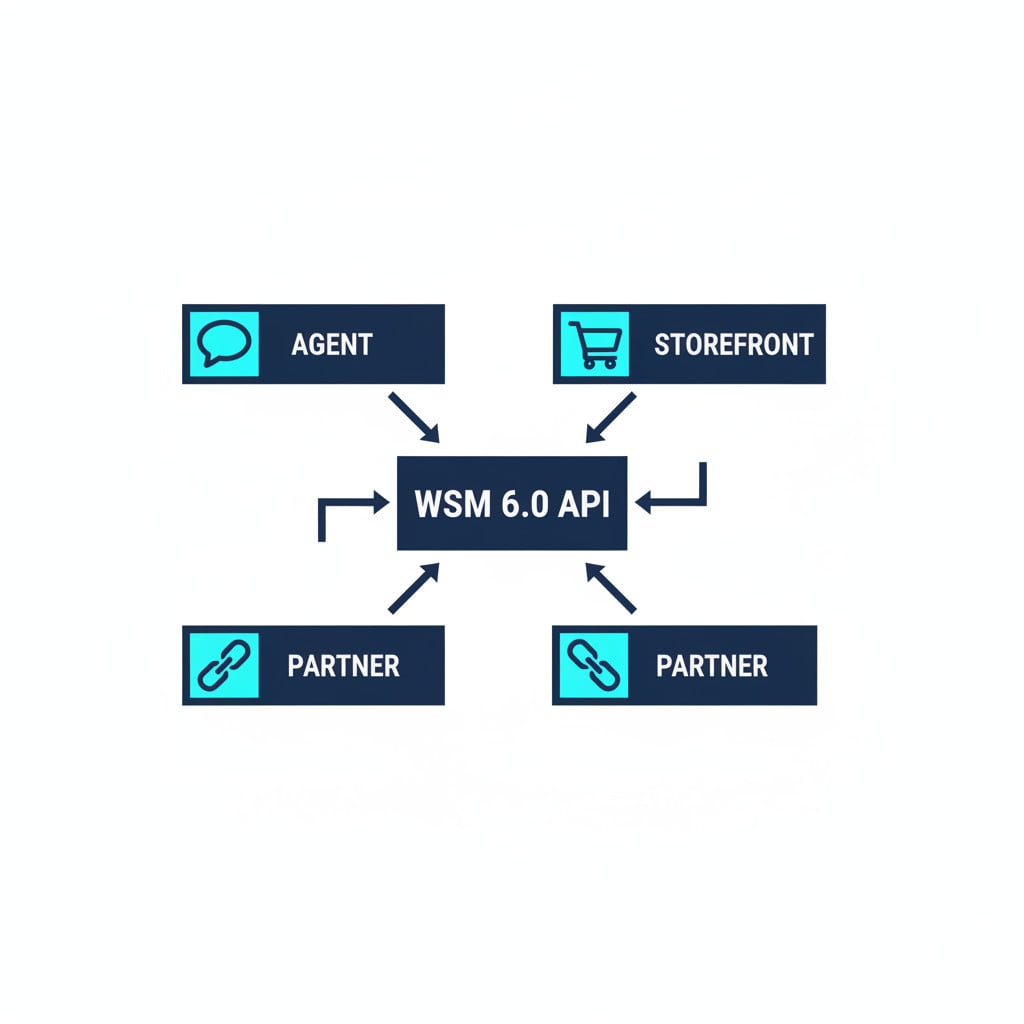
WSM 6.0 was rearchitected from the ground up around an open-architecture assumption. The stack is fully headless with Python at the data layer, GraphQL as the primary query interface, and React on the frontend. That same shape is what makes fitment data reachable by machines rather than only by browsers; headless and composable commerce for aftermarket catalogs walks through how it is evaluated. Every part of the buying flow that a human can complete in a browser, an agent can complete through GraphQL.
Concretely, what that means in production:
- Product, fitment, kit, and inventory data are exposed as GraphQL types. An agent reads them through a single typed query.
- The cart is a stateful resource. An agent creates, modifies, and submits it through mutations.
- Checkout completes through an API flow that does not require browser cookies, popups, or external redirects.
- Webhook events fire on order completion, inventory changes, and pricing updates. Agents can subscribe.
- The same data layer that powers the human storefront powers the AI experience. There is no separate “AI API” that drifts out of sync with the production catalog.
This is the structural condition that makes AI-ready commerce a deployment decision on WSM 6.0 rather than a platform migration. The platform that powers $400M+ in annual online sales for shops like Fuel Moto, ECGS, and Suncoast was built so the agent integration is the same API surface the human storefront already uses.
Where the divergence shows up
If you are evaluating platforms in 2026 with the agent channel in mind, the table below is where the architectural difference shows up in real operations.
| What an agent needs | Open architecture (API-first) | Closed platform | Effect on the agent |
|---|---|---|---|
| Product + fitment query | Single typed GraphQL query returns catalog, fitment, attributes, kits | Multiple REST endpoints with vendor-specific schemas; partnership required for full access | Agent recommends accurately, or guesses and reverses |
| Cart construction | Stateful cart resource via mutations; agent can add, modify, validate | Browser-session cart with JavaScript event handlers | Agent fails at add-to-cart silently |
| Payment authentication | API-based payment intent; programmatic auth with no popup | Stripe redirect, 3DS popup, “I agree” checkbox | Agent cannot complete authentication; transaction abandoned |
| Order confirmation | Confirmation returned synchronously through API; webhook for downstream events | Confirmation page rendered for browser; webhook varies by app store extension | Agent cannot verify order completion; buyer ends in support queue |
| Integration model | Open API; agent integrates without vendor sign-off | App-store gated or partnership-gated; vendor controls the integration surface | Agent skips the store entirely; never tries the integration |
A useful pattern we see
Operators choosing platforms in 2026 are not really choosing between feature sets. They are choosing between architectural assumptions about who the buyer is. The platforms that assume the buyer is always a human in a browser are not wrong about today’s traffic, but they are wrong about tomorrow’s. The platforms that assume the buyer may be a human, an agent, or both, and that the integration surface has to work for either, are building for the channel that is actually coming.
The retroactive cost of choosing the wrong architecture is the one that surprises operators. App-store ecosystems and closed integrations were the safe choice in 2020. They are the expensive choice in 2026 because they cannot be opened later without a platform migration.
If your platform requires a partnership for an agent to read your catalog, the agent has already moved on. The recommendation it makes next is the recommendation that compounds.
Related reading in the AI commerce cluster
- AI-Ready Commerce for Complex eCommerce: the foundational hub explaining what AI readiness means operationally for complex catalogs
- AI Agents Are Shopping for Your Customers. Can Your Store Take Their Money? Why most platforms structurally cannot complete agent-initiated transactions
- The CPC Math Just Changed: AI Is a Paid Acquisition Channel Now: what OpenAI’s $60 CPM launch means for 2026 ad budgets
- AI Doesn’t Fix Bad Catalog Data. It Amplifies It. Why structured product data and ACES/PIES discipline determine AI commerce success
Get more from Web Shop Manager in Google Search:



Get in touch with us
Reach out to us for any inquiries or support, and let’s connect!


More On Related Topic
Explore our highlighted blogs for the latest insights and trends in the industry.
Social Media Optimization: Maximize Your Time with These SEO Tips
Web Shop Manager - Social Media OptimizationWe all know there should be 26 hours in the day. Could that be a Christmas gift? No? Yeah, that’s what I thought. We only have so much...
3 Tips on How to Make Money Writing Blogs (SEO Optimized)
Web Shop Manager - How To Make Money Writing BlogsThe ultimate goal of an eCommerce blog is to make money. It may be a simple goal of paying your eCommerce hosting fees or perhaps you have grander visions...
5 Tactics to Recover Abandoned Cart Sales Now
Recover Abandoned Cart Sales with These 5 TacticsRecover Abandoned Cart Sales with These 5 TacticsYou’ve done everything right. Your store is set up with eye-popping images, your content is fresh and engaging, site speed...

Ready To Grow Your Business?
Ready to grow your aftermarket eCommerce presence and lift conversions across auto, truck, powersports, marine, and more? Connect with
Web Shop Manager for tailored solutions: strategy, platform, and performance in one team.