Web Shop Manager vs BigCommerce
How Web Shop Manager compares to BigCommerce on the criteria that decide it at aftermarket scale — fitment depth, ACES/PIES automation, hybrid B2B/B2C platform patterns, structured data, and AI that runs on real catalog data.
Representative pattern, not a verbatim customer quote
BigCommerce gave us more out of the box than any SaaS platform we’d evaluated. We still ended up building our YMM lookup, our ACES/PIES sync, and our dealer-portal logic ourselves — because the platform is general-purpose and our catalog is not.
Why compare Web Shop Manager and BigCommerce?
For parts sellers evaluating a BigCommerce alternative, the real question is not whether BigCommerce is a good platform — it is — but whether a general-purpose mid-market platform serves a fitment-driven catalog as well as one built specifically for aftermarket commerce. BigCommerce is one of the strongest SaaS commerce platforms available. Strong native APIs, generous feature set without app dependency, B2B Edition included on Enterprise, and Catalyst as a credible Next.js headless storefront accelerator. It belongs in any serious comparison set.
The question isn’t whether BigCommerce can run an auto-parts storefront. It can. The question is whether the architecture — powerful general-purpose commerce with specialized capabilities added via apps or custom development — produces the same fitment, ACES/PIES, and catalog-data outcomes as a platform where those capabilities are the design center.
- Fitment isn’t a native concept in the catalog model. BigCommerce’s catalog model is product-options + custom fields + categories — flexible, but YMM and qualifier-depth come from third-party apps or custom development on top of that data model.
- ACES/PIES is not a native data structure. Aftermarket catalog standards live outside BigCommerce’s product model. Operators bring ACES/PIES in through custom integrations or third-party services that have to be maintained as suppliers change their feeds.
- B2B Edition is strong — and Enterprise-scoped. BigCommerce B2B Edition is included on Enterprise plans — quote workflows, company accounts, sales reps, price lists. It’s strong functionality, but it lives at the Enterprise tier and is configured as a B2B layer alongside B2C.
- Catalyst is a strong headless story — and a project. Catalyst gives BigCommerce a credible Next.js storefront accelerator, on par with Hydrogen for Shopify. The implementation is still a codebase your team or agency owns end-to-end. WSM 6.0 ships with the Next.js / GraphQL storefront path included.
- The app footprint is smaller than Shopify’s — but aftermarket gaps still get filled by third parties. A production aftermarket BigCommerce store still runs a meaningful app stack across payments, shipping, B2B, fitment, search, security, SEO, analytics, and integrations — lighter than the WordPress/Shopify worlds, but the fitment, ACES/PIES, and aftermarket-specific catalog logic still come from outside the platform core.
What to evaluate when comparing WSM and BigCommerce
If you’re a shop owner, distributor, or manufacturer comparing these two, the six things below are what actually shift once you’re ninety days into operations.
Catalog complexity at scale
BigCommerce handles large catalogs efficiently and the platform performance is strong. The question is what the data model treats as first-class. WSM’s catalog is built around fitment-driven structures — vehicle qualifiers, kit relationships, supersessions, supplier-feed reconciliation. BigCommerce’s catalog is products + options + custom fields, with fitment-aware behavior built on top.
Fitment depth, not just YMM extension presence
BigCommerce can show a Year/Make/Model dropdown via third-party apps or custom development against the Catalog API. The depth question is what happens at the qualifier level — engine, trim, bed length, doors — when fitment is the actual conversion decision. PartsLogic prompts for the qualifier that matters before checkout, natively. On BigCommerce, that flow is built per-store.
Native WSM B2B vs. BigCommerce B2B Edition
If you sell to dealers, WSM treats account-based pricing, PO checkout, and dealer logins as built-in platform patterns. BigCommerce B2B Edition is a strong capability set associated with Enterprise scope and configuration — company accounts, quotes, price lists, sales reps — configured as a B2B layer alongside B2C.
ACES/PIES automation
BigCommerce can ingest ACES/PIES via custom integrations or third-party services. The differentiator is whether the catalog stays in sync without manual reconciliation eating labor at scale. WSM’s data-services layer was built around this — including AI Catalog Bridge, which auto-detects PIES/ACES, maps any supplier CSV column-by-column with AI, and runs scheduled FTP/SFTP pulls.
Headless: Catalyst as a project, WSM 6.0 as shipped
Both platforms have strong headless stories. Catalyst gives BigCommerce a Next.js storefront accelerator with a clear path from spin-up to production — merchants or agencies own the storefront codebase, deployment, and upgrade path. WSM 6.0 ships with the Next.js / GraphQL storefront included.
AI readiness and aftermarket catalog-data foundation
WSM ships Mercedes and AI Catalog Bridge today for AI-assisted catalog work: PIES/ACES auto-detection, supplier CSV mapping, and scheduled FTP/SFTP pulls. Fitment Q&A, customer support, and merchandising AI continue expanding on the same structured-data foundation.
Quick answer: where each platform fits best
The honest answer is that the better platform depends on what your shop needs to do at scale. WSM is a strong BigCommerce alternative for aftermarket sellers who need native fitment, ACES/PIES workflows, B2B handled as a WSM platform pattern, and a platform where the specialized aftermarket capabilities are primitives rather than apps and custom development.
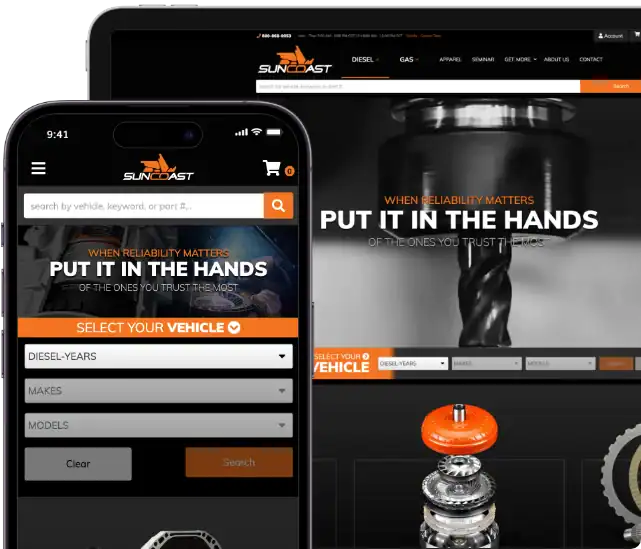
Choose Web Shop Manager if: fitment is your conversion lever, ACES/PIES is your data backbone, you sell to both dealers and retail customers from the same catalog, and you want a platform that has been running aftermarket sites for 25+ years. We currently power $400M+ in annual online sales for shops like Fuel Moto, ECGS, and Suncoast. The pattern we see: aftermarket operators who choose BigCommerce get a strong mid-market platform with fewer app dependencies than Shopify — and still end up building the fitment, ACES/PIES, and aftermarket-specific catalog logic themselves.
Choose BigCommerce if: your catalog is general-purpose with some specialization needs, you want a mid-market SaaS platform with strong native APIs, B2B Edition aligns with your B2B requirements at the Enterprise tier, and you have or are willing to invest in agency or in-house capacity to build the aftermarket-specific layer on top. BigCommerce is excellent for mid-market merchants who want SaaS with developer-friendly APIs.
Where the two platforms diverge
BigCommerce and WSM solve different problems, even though both can claim aftermarket capability. Ten places where the difference shows up in real operations:
| Capability | Web Shop Manager | BigCommerce | What it means for the operator |
|---|---|---|---|
| Fitment verification depth | Native YMM included in WSM platform tiers + PartsLogic qualifier prompts (trim, engine, bed length, doors) before checkout | Not native — fitment is added via third-party apps or custom development against the Catalog API; qualifier handling per-store | WSM gates the qualifier before purchase as platform default; on BigCommerce the same flow is a build on top of the catalog model |
| Fitment-aware kits and bundles | Native — kit fitment is computed from every component’s YMM compatibility, so a bundle only shows for vehicles where every part actually fits | Product options and complex SKUs supported natively; per-component fitment validation is a custom build on top of the data model | reduces wrong-fit returns on kit purchases, where a single component mismatch ruins the whole order |
| AI-driven catalog import | AI Catalog Bridge — drop any supplier CSV and AI auto-maps the columns; auto-detects PIES/ACES; scheduled FTP/SFTP pulls; round-trip exports where mappings stick across re-imports | Native CSV import + strong Catalog API; AI-driven mapping and PIES/ACES auto-detection are third-party or custom-build territory | Catalog-team time per new supplier-feed onboarding drops from hours per feed to minutes |
| ACES/PIES sync | Automated nightly sync; data-services team manages drift | Available via custom integration or third-party connector; ongoing sync model is yours to design | Manual ACES/PIES reconciliation eats meaningful labor at scale |
| B2B + B2C in one platform | Native — account pricing, PO checkout, dealer login, retail flow on the same backend as a platform-default pattern | B2B Edition included on Enterprise — company accounts, quotes, price lists, sales reps — configured as a B2B layer alongside B2C | B2B is platform-default across the WSM platform vs. unlocked at the Enterprise tier on BigCommerce |
| App and dependency footprint | Single managed platform — fitment, B2B, ACES/PIES, data services, infrastructure, and managed updates all included | Production aftermarket stores still run a meaningful app stack across payments, shipping, B2B, fitment, search, security, SEO, analytics, and integrations — lighter than the Shopify ecosystem, but still the dependency surface for aftermarket-specific capability | Fewer apps than Shopify, but the apps you do run are the aftermarket-specific layer |
| Native APIs and developer surface | GraphQL commerce API, modular app marketplace, full headless storefront shipped on Next.js | REST and GraphQL Storefront APIs, strong developer tooling, Catalyst as Next.js storefront accelerator — merchant or agency owns the storefront codebase | Both platforms are API-first; difference is whether the storefront ships with the platform or is implemented on top of it |
| Architecture | WSM 6.0 — fully headless, Next.js storefronts on a GraphQL commerce API, modular app marketplace | Stencil storefronts with strong headless support via Catalyst (Next.js) — merchants or agencies own the headless storefront codebase and deployment | Both platforms have modern architecture; the difference is whether the storefront ships included or is implemented on top of the platform |
| Native AI agent (Mercedes) | Ships today for catalog work (AI Catalog Bridge: PIES/ACES auto-detect, supplier CSV mapping, FTP/SFTP scheduling). Fitment Q&A and customer-support capabilities expanding next on the same structured-data foundation | Developing AI story focused on merchant productivity and search recommendations; aftermarket-specific catalog logic remains a custom build | AI on top of native fitment depth is leverage; AI on top of generic catalog data produces generic answers, not fitment-specific guidance |
| AI search visibility (AEO) | Full Product schema on every page (name, brand, SKU, price, availability) plus llms.txt for AI discovery. All AI crawlers allowed in robots.txt. WSM-powered stores may be cited by ChatGPT, Perplexity, and Google AI Overviews; citation outcomes vary by store and query | Product schema available via theme or SEO setup; llms.txt and AI-citation tuning per-store | The next surface buyers find parts on isn’t only Google — it’s AI assistants citing the underlying data |
What ships inside Web Shop Manager 6.0
WSM 6.0 is built as a set of named, modular capabilities — not a paid app bundle. The five that matter most for an aftermarket comparison:
Mercedes
Native AI agent grounded in your structured catalog. Ships today for catalog work; fitment Q&A and customer-support roles expanding next.
AI Catalog Bridge
Drop any supplier CSV — AI auto-maps the columns. Auto-detects PIES/ACES. Scheduled FTP/SFTP pulls. Round-trip exports where mappings stick across re-imports.
PartsLogic Smart Search
Natural-language search tuned for aftermarket queries. Understands “F-150 2018 SuperCrew bed cover” the way a parts counter would. Qualifier prompts before checkout.
AEO & AI citation
Full Product JSON-LD schema (name, brand, SKU, price, availability), llms.txt on every storefront, AI crawlers allowed in robots.txt. WSM-powered stores may be cited by ChatGPT, Perplexity, and Google AI Overviews — citation outcomes vary by store and query.
Local SEO
For shops with physical locations: LocalBusiness schema, location-aware fitment pages, structured store data optimized for local search and AI-assistant pickup.
Why aftermarket operators evaluate WSM differently
Shop owners with compatibility-driven catalogs ask different questions than general-retail merchants. They care less about the storefront theme and more about: can the catalog stay in sync with my supplier data? Can my dealer accounts buy in bulk from the same platform retail customers use? When a buyer searches for “F-150 2018 SuperCrew bed cover,” do they land on a part that actually fits or do they call my support team?
- Cut wrong-fit returns through fitment verification at the qualifier level — not just a YMM plugin/app that still requires custom qualifier logic around engine, trim, bed length, doors, and compatibility rules.
- Ship kits and bundles with verified fitment — kit fitment is computed from every component’s YMM data, so customers only see kits where every part fits their vehicle. Mismatch on a single component in a kit returns every part in that order.
- Onboard a new supplier feed in minutes, not hours — AI Catalog Bridge auto-maps any CSV (even messy PIES/ACES files) to your catalog. Round-trip edits stick.
- Eliminate the manual ACES/PIES reconciliation overhead by automating nightly sync against supplier feeds.
- Run B2B and B2C from one catalog without a tier upgrade or app stack — dealer pricing, PO checkout, retail flow, all native.
- Iterate storefront UX without rebuilding because the WSM 6.0 architecture is fully decoupled, shipped not assembled.
- Get AI that actually answers fitment questions because Mercedes runs on top of structured data, not on top of static product descriptions.
- Lean on 25 years of aftermarket operations experience — WSM has run platforms for shops in your exact configuration before.
- Operate with one accountable team — tech, hosting, data, and support owned by WSM, not coordinated across the platform, an app vendor, and a development partner.
Where this comparison points next
If you’ve read this far, you’re past general-platform comparison and into operational specifics. The pages below go deeper on the WSM mechanisms that show up in this comparison — Year/Make/Model lookup, the ACES/PIES data layer, PartsLogic search, and the AI-ready commerce surface Mercedes runs on.
Looking for a BigCommerce alternative built for fitment-first commerce?
If you’re on BigCommerce and you’re hitting the ACES/PIES reconciliation wall, the limits of variant + custom-field modeling for fitment-driven catalogs, the B2B Edition tier gate, the cumulative cost of building the aftermarket-specific layer on top, or you’re weighing a custom build against a platform where these capabilities are native — or you’re evaluating a BigCommerce alternative built specifically for aftermarket and parts commerce — we’ll show you what the actual evaluation looks like with your catalog in front of us.
WSM vs BigCommerce at a glance
A quick scan of where each platform stands on the dimensions that matter most for parts-driven merchants.
| Dimension | Web Shop Manager | BigCommerce |
|---|---|---|
| Native fitment (Year/Make/Model)Built into the platform, not added via plugin. | ✓First-class | −App / custom implementation |
| ACES & PIES supportIndustry-standard structured data for aftermarket catalogs. | ✓Native | −Custom integration |
| Hybrid B2B / B2C in one storeDealer pricing, gated catalogs, RFQ, net terms — same store as retail. | ✓Default | −B2B Edition; Enterprise scope |
| Fitment-aware structured dataSchema.org output tuned for aftermarket queries. | ✓Built-in | −Theme/app/custom setup |
| PartsLogic Smart Search + Mercedes AIGuided discovery and AI assistance designed for complex catalogs. | ✓Included | −BigCommerce AI / custom aftermarket logic |
| Migration playbook for aftermarketRedirect audit, ACES normalization, fitment re-indexing. | ✓Standard | −Bespoke |
This is a positioning summary, not a feature audit — every platform has nuance. Talk to a specialist for a TCO comparison against your real catalog.
Frequently asked questions
The questions parts-driven merchants ask most often when comparing BigCommerce to WSM.
Yes — particularly for aftermarket operators where fitment, ACES/PIES, B2B, and supplier-feed automation are core requirements rather than capabilities built on top of a strong general-purpose commerce platform. WSM ships fitment depth and qualifier prompts natively, automates ACES/PIES reconciliation, supports B2B as a platform-native pattern, and ships the Next.js / GraphQL storefront in the platform tier. The BigCommerce alternative case is about getting these capabilities as primitives instead of building them on top of a strong SaaS commerce core.
Compare them on the operational specifics that show up at scale: fitment as a platform-default pattern versus fitment through an app, connector, or custom implementation; ACES/PIES automation depth; B2B as a WSM platform pattern versus BigCommerce B2B Edition and Enterprise configuration requirements; headless out-of-the-box versus a Catalyst project; and the multi-year total cost of ownership including platform tier, aftermarket-specific apps or custom layer, and developer time.
Yes, for operators who want a strong mid-market SaaS platform with developer-friendly APIs, a mature commerce foundation, and BigCommerce B2B Edition where Enterprise scope and configuration fit the business model. BigCommerce is one of the most capable general-purpose commerce platforms available. The question on this page is not whether BigCommerce can run an auto-parts storefront. It is whether the architecture — powerful general-purpose commerce with aftermarket capabilities built on top — lines up with what a fitment-native platform delivers without the build.
No. WSM is a serious investment compared with running on BigCommerce with a lean app stack. WSM is the right fit when fitment depth, ACES/PIES automation, B2B-native workflows as WSM platform patterns, headless out-of-the-box, and 25 years of aftermarket operations experience justify the difference. If your catalog is general-purpose with selective specialization needs, BigCommerce may be the right path.
A platform can add a Year/Make/Model capability via an app or custom development and still fail at the qualifier level. The qualifier — engine, trim, bed length, doors, cab style, or other compatibility detail — is where wrong-fit returns happen. On BigCommerce, qualifier handling depends on which app you used or what your team built against the Catalog API. WSM treats qualifier depth as part of the platform pattern.
Structured product data is what makes search, filtering, AI, and dealer-data handoff work reliably. Without it, every new SKU is a manual entry, every supplier update is a reconciliation project, and every fitment dispute eats margin. On BigCommerce, ACES/PIES workflows generally require apps, custom integrations, or third-party services. In WSM, structured aftermarket catalog data is part of the platform foundation.
AI is only useful where structured data is already in place. WSM ships Mercedes and AI Catalog Bridge today for AI-assisted catalog work, including PIES/ACES auto-detection, supplier CSV mapping, and scheduled FTP/SFTP pulls. Fitment Q&A, customer support, and merchandising AI continue expanding on the same structured-data foundation. BigCommerce's AI roadmap and platform direction focus on merchant productivity, search, and general commerce workflows; aftermarket-specific catalog logic remains an implementation question.
This comparison is for operators running large or growing catalogs in automotive, truck, diesel, powersports, off-road, or adjacent technical categories who are already on BigCommerce, evaluating it against a fitment-native platform, or weighing whether the next investment should be more BigCommerce customization, B2B Edition / Enterprise scope, a Catalyst project, or a move to a specialized aftermarket commerce platform.
WSM fits best when the cost of the platform is justified by the operational cost of not having native ACES/PIES workflows, native B2B platform patterns, native fitment depth, multi-storefront capability, and a single accountable platform team. BigCommerce's strongest case is mid-market and enterprise merchants who want a strong general-purpose SaaS platform with native APIs, BigCommerce B2B Edition where Enterprise scope fits, and Catalyst as a credible headless path.
BigCommerce plans run from Plus to Pro to Enterprise, with B2B Edition associated with Enterprise scope and configuration. the useful comparison for an aftermarket operator is total annual operating cost: platform tier, fitment app or build, ACES/PIES connector, B2B requirements, Catalyst or storefront implementation needs, and any custom development for aftermarket-specific catalog logic. WSM includes native fitment, B2B patterns, and ACES/PIES capabilities without requiring a separate app stack for those foundational features.
Migration timing depends on catalog size, data quality, integrations, URL history, and launch requirements. Many WSM migrations are scoped in the 2–4 week range, but timing and downtime should be confirmed during discovery. The migration plan should map redirects, product data, customer/account data, app dependencies, custom workflows, and any BigCommerce-specific implementation details before launch.
The audit maps every app and custom build in the current BigCommerce install to a WSM-native capability, WSM integration path, or custom requirement. Fitment, ACES/PIES, B2B, multi-storefront, search, and core data-services capabilities are native WSM platform patterns. Specialized apps or integrations for ERPs, payment gateways, marketing automation, analytics, or other workflows are reviewed before launch so the business understands what carries over, what reconnects, and what needs to be rebuilt.
See WSM through the lens of BigCommerce
Catalog complexity, fitment, ACES & PIES, structured data — the things that decide whether a platform actually works for parts-driven merchants.