Web Shop Manager vs Custom Development
How buying Web Shop Manager compares to commissioning a custom aftermarket build — on time-to-launch, total cost over three years, maintenance ownership, native primitives vs. specification, modern architecture, and AI on top of structured data.
“We went the custom-build route for our first aftermarket platform. Eighteen months in, we owned every line of code, every integration, every bug, and the upgrade path. We didn’t realize we were buying a development team, not a platform.”
Why compare Web Shop Manager and a custom development build?
For parts sellers evaluating a custom aftermarket build — whether through a dedicated dev shop, an in-house engineering team, or a contracted agency — the real question is not only who builds it, it is whether to buy a platform at all or hire a dev team to build a custom one. Custom development is a legitimate path with real merits: a codebase tuned exactly to spec, total architectural control, and freedom from platform constraints. It belongs in the evaluation set for operators with the engineering capacity to design, maintain, and evolve their own commerce stack.
The question isn’t whether a custom-build path can deliver an auto-parts storefront. With the right team, it can — and the build can be tuned exactly to your spec. The question is whether buying an aftermarket platform with 25 years of operational history, native fitment, ACES/PIES, B2B, AI, and a 1,763-brand operational track record is a better operational choice than commissioning a custom build, owning the resulting codebase, and committing to ongoing development to maintain and evolve it.
- Platform vs. dev shop is buy-vs-build, not feature-vs-feature. Both paths can produce a working aftermarket storefront. The difference is what you own afterward: a platform with managed updates and a roadmap, or a custom codebase that requires ongoing dev capacity to maintain.
- Time to launch differs dramatically. Platform purchase + migration is often scoped far faster than a custom build, with many WSM migrations scoped in the 2–4 week range depending on catalog size, data quality, integrations, URL history, and launch requirements. A meaningful custom build often lands in the 6–12 month range, depending on scope, integration count, QA, and post-launch iteration.
- Vendor / team continuity is a real risk to evaluate. When the dev shop’s lead architect moves on, when a key contractor turns over, when the agency reorganizes — what happens to your platform? Buying a platform shifts that risk to the platform vendor; building custom keeps it with you.
- Maintenance is the rest of the conversation. The initial build is one cost; keeping pace with payment-processor API changes, browser security patches, dependency upgrades, and modern-architecture moves (headless, AI, AEO) is the bigger one. Platforms ship those changes; custom builds wait for your dev team or retainer to ship them.
- Specialized aftermarket capability differs between “built once” and “continuously evolved.” A platform investing in fitment, AI Catalog Bridge, Mercedes, and AEO across a 1,763-brand customer base improves on those primitives every quarter. A custom build improves only as fast as your dev team and budget allow.
What to evaluate when choosing platform vs. custom build
If you’re weighing a custom development build against a productized platform, the six things below are what actually shift the cost curve once you’re a year in.
Time to launch
WSM migration timing depends on catalog size, data quality, integrations, URL history, and launch requirements. Many WSM migrations are scoped in the 2–4 week range once catalog data and launch requirements are clear. A meaningful custom aftermarket build typically lands at 6-12 months, depending on scope and how much fitment/B2B/data-services scaffolding has to be built from scratch. The launch-time difference compounds across competitive cycles.
Initial build vs. platform purchase economics
Serious aftermarket custom-build investments often run into six figures once you include discovery, design, build, integration, QA, and launch — plus the contingency reserves for scope creep. Platform purchase replaces that with a recurring fee and a migration project. Year-1 economics often look comparable; year-3 economics diverge sharply.
Ongoing maintenance ownership
Custom builds put you on the maintenance retainer treadmill: WordPress / framework updates, payment-processor API changes, browser security patches, dependency upgrades, modern architecture moves. Platform purchases shift that work to the vendor — you pay the platform fee; we ship the patches and upgrades.
Catalog data model: shipped vs. designed-from-scratch
WSM ships fitment-driven catalog structures — vehicle qualifiers, kit relationships, supersessions, supplier-feed reconciliation — tested across 25 years and 1,763 brands. A custom build designs that data model from scratch, which works, but means the patterns aren’t already battle-tested across hundreds of catalogs.
Fitment, ACES/PIES, B2B: native primitives vs. specifications
WSM ships these as platform-native capabilities. A custom build implements them to your spec — which can be exactly what you want, but means the build cost, the test cycle, and the maintenance ownership all live with you.
Modern architecture: shipped vs. project
WSM 6.0 ships fully headless — Next.js storefronts on a GraphQL commerce API — with the storefront codebase included. A custom build can certainly land on modern architecture; the headless storefront, the GraphQL layer, the AI integration, and the AEO surface all have to be specified, built, tested, and maintained.
Quick answer: where each path fits best
The honest answer is that the better path depends on what your organization actually wants to own.
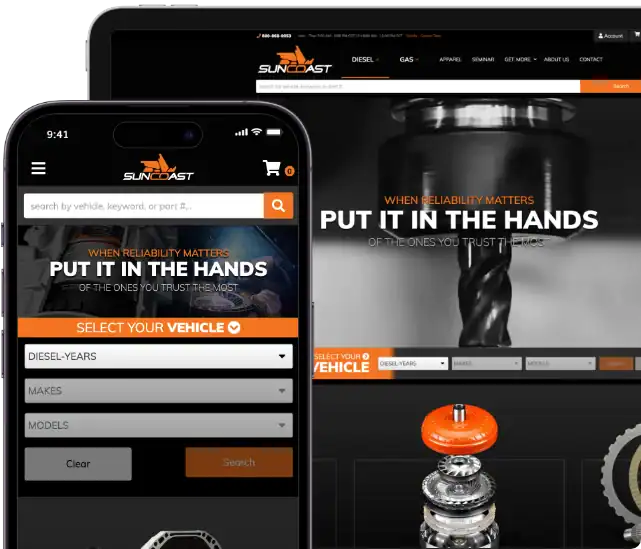
Choose Web Shop Manager if: you want a productized platform with native fitment, ACES/PIES, B2B, AI, and managed updates — with the maintenance work and the modernization roadmap owned by the vendor. We currently power $400M+ in annual online sales for shops like Fuel Moto, ECGS, and Suncoast. The pattern we see: operators who go custom-build first often migrate to a platform after the second or third maintenance cycle, when the cost of ongoing dev ownership becomes the dominant line item.
Choose a custom development build if: you want a custom codebase tuned exactly to your spec, your organization has in-house or contracted dev capacity to maintain and evolve it, the differentiation from a productized platform is worth the ongoing maintenance ownership, and you’ve evaluated multi-year total cost including build, ongoing maintenance, and modernization moves against a productized platform alternative.
Where platform and custom-build diverge
Buying a platform and hiring a dev shop solve different problems even when the end-state storefront looks similar. Ten places where the difference shows up over a multi-year operating window:
| Capability | Web Shop Manager | a custom development build | What it means for the operator |
|---|---|---|---|
| Time to launch | Many WSM migrations are scoped in the 2–4 week range depending on catalog size, data quality, integrations, URL history, and launch requirements | Often 6–12 months for a serious aftermarket custom build, depending on scope, integration count, QA, and post-launch iteration | Launch-time difference compounds across competitive cycles |
| Initial cost structure | Platform tier plus migration fee; predictable recurring | Often six-figure total project investment including discovery, design, development, integration, QA, launch, and contingency reserves | Compare year-1 vs. year-3 total cost including ongoing maintenance, not just the initial line item |
| Ongoing maintenance ownership | WSM owns platform updates, security patches, browser compatibility, payment-processor API changes | Merchant or retainer owns ongoing maintenance: framework updates, patches, API changes, modernization | Maintenance is the cost line that compounds; whoever owns it shapes the multi-year cost curve |
| Fitment, ACES/PIES, B2B | Native primitives shipped, tested across 25 years and 1,763 brands | Implemented to your spec; tested against your catalog; owned end-to-end | Specification flexibility vs. battle-tested patterns; both are valid choices |
| AI capabilities | Mercedes and AI Catalog Bridge ship today for AI-assisted catalog work; fitment Q&A and merchandising AI continue expanding on the structured-data foundation | AI features built to spec on your custom platform; integrated and maintained by your dev team | AI moves fast; platform-shipped AI compounds across the customer base; custom AI compounds only on your build |
| Modern architecture (headless) | WSM 6.0 ships fully headless — Next.js storefronts on a GraphQL commerce API; storefront codebase included | Architecture is whatever the build specifies; headless, GraphQL, AI integration, AEO all designed and maintained per-build | Modern architecture is moving; platform-shipped infrastructure stays current automatically |
| Vendor / team continuity risk | Platform vendor commitment; 25-year operational track record; established product team | Risk lives with the dev shop or in-house team; key-person turnover affects your platform directly | Vendor risk vs. team-continuity risk are both real; the question is which one you’re better positioned to absorb |
| Modernization roadmap | Platform roadmap moves across the 1,763-brand customer base — you benefit from upgrades that ship to everyone | Modernization happens only as fast as your dev capacity and budget allow | Compounding-roadmap effect favors platform purchases over multi-year horizons |
| AI search visibility (AEO) | Full Product schema on every page (name, brand, SKU, price, availability) plus llms.txt for AI discovery. All AI crawlers allowed in robots.txt. WSM-powered stores may be cited by ChatGPT, Perplexity, and Google AI Overviews; citation outcomes vary by store and query | AEO and AI-citation surface built to spec on your custom platform; maintained per-store | The next surface buyers find parts on isn’t only Google — it’s AI assistants citing the underlying data |
| Customer scale and operational track record | Named customers including Fuel Moto, ECGS, Suncoast; platform handles 1,763 brands; $2.5B+ processed across 25 years | Track record is the dev shop’s portfolio and your own build’s operational history once live | Specific outcomes from named customers + multi-decade platform lineage beats portfolio-only positioning |
What ships inside Web Shop Manager 6.0
WSM 6.0 is built as a set of named, modular capabilities — not a build-from-scratch project. The five that matter most for an aftermarket comparison:
Mercedes
Native AI agent grounded in your structured catalog. Ships today for catalog work; fitment Q&A and customer-support roles expanding next.
AI Catalog Bridge
Drop any supplier CSV — AI auto-maps the columns. Auto-detects PIES/ACES. Scheduled FTP/SFTP pulls. Round-trip exports where mappings stick across re-imports.
PartsLogic Smart Search
Natural-language search tuned for aftermarket queries. Understands “F-150 2018 SuperCrew bed cover” the way a parts counter would. Qualifier prompts before checkout.
AEO & AI citation
Full Product JSON-LD schema (name, brand, SKU, price, availability), llms.txt on every storefront, AI crawlers allowed in robots.txt. WSM-powered stores may be cited by ChatGPT, Perplexity, and Google AI Overviews — citation outcomes vary by store and query.
Local SEO
For shops with physical locations: LocalBusiness schema, location-aware fitment pages, structured store data optimized for local search and AI-assistant pickup.
Why aftermarket operators evaluate platform purchase differently than custom build
Shop owners with compatibility-driven catalogs ask different questions than operators considering generic eCommerce builds. The build-vs-buy decision shows up across these axes:
- Cut wrong-fit returns through fitment verification at the qualifier level on day one — not after the custom YMM and qualifier-prompt logic ships in a later phase of the build.
- Ship kits and bundles with verified fitment using a kit-fitment computation tested across 25 years and 1,763 brands — not specified, built, and tested per project.
- Onboard a new supplier feed in minutes, not weeks — AI Catalog Bridge auto-maps any CSV. A custom build delivers the catalog-import experience your spec describes; whether AI mapping ships in v1 depends on the build scope.
- Eliminate the manual ACES/PIES reconciliation overhead via a platform that automates nightly sync across the customer base — not via a custom integration that you maintain.
- Run B2B and B2C from one catalog using platform-native primitives, not custom-built role-based pricing layers.
- Iterate storefront UX without rebuilding because the WSM 6.0 architecture is fully decoupled, shipped not assembled — the Next.js / GraphQL storefront ships with the platform.
- Get AI that compounds across the customer base — Mercedes ships to everyone on WSM; AI on a custom build improves only as fast as your dev team ships it.
- Lean on 25 years of aftermarket operations experience baked into the platform primitives — not just baked into your dev shop’s institutional knowledge.
- Operate with one accountable team — tech, hosting, data, and support owned by WSM, not coordinated across a dev shop, an integration partner, and a hosting provider whose accountability boundaries shift with each escalation.
Where this comparison points next
If you’ve read this far, you’re past general platform-vs-build framing and into operational specifics. The pages below go deeper on the WSM mechanisms that ship with the platform — Year/Make/Model lookup, the ACES/PIES data layer, PartsLogic search, and the AI-ready commerce surface Mercedes runs on.
Looking for an alternative to commissioning a custom aftermarket build?
If you’re evaluating a custom development build and you’re weighing the build cost, the launch timeline, the ongoing maintenance ownership, the vendor / team continuity risk, or the multi-year economics against a productized platform — or you’re already partway through a custom build and reconsidering the trajectory — we’ll show you what the actual evaluation looks like with your catalog in front of us.
Frequently asked questions
The questions parts-driven merchants ask most often when comparing Custom Development to WSM.
Yes — particularly for aftermarket operators where fitment, ACES/PIES, B2B, and AI-readiness are core requirements that get more valuable over time. WSM ships those capabilities natively, with a 25-year operational track record across 1,763 brands. A custom build can deliver exactly what you specify; a productized platform delivers proven primitives plus an ongoing modernization roadmap that compounds across the customer base.
It is a buy-vs-build decision, not a feature-vs-feature one. Compare the paths on time to launch, initial cost structure, ongoing maintenance ownership, modernization roadmap, and vendor / team continuity risk. For WSM, migration timing depends on catalog size, data quality, integrations, URL history, and launch requirements; many WSM migrations are scoped in the 2–4 week range. For custom builds, timing depends on discovery, design, implementation, integration count, QA, launch scope, and post-launch iteration.
Yes — a custom development path can be credible when the merchant has the budget, technical oversight, and long-term development capacity to own the resulting codebase. The question on this page is not whether custom development can build an auto-parts storefront. It is whether commissioning a custom build is the right operational choice versus buying a productized platform with native fitment, ACES/PIES, B2B, AI, and a 25-year operational track record.
No. WSM is a productized platform; if your business case requires a custom codebase tuned exactly to your spec and you have in-house or contracted development capacity to maintain it, a custom build with an agency, dev shop, or in-house engineering team may be the right path. WSM is the right fit when fitment, ACES/PIES, B2B-native workflows as WSM platform patterns, AI, and managed updates justify shifting maintenance ownership to the platform vendor.
Year-one economics can look comparable: a serious custom build versus platform fee plus migration. Year two and year three often diverge once you add ongoing maintenance, framework updates, security patches, payment-processor API changes, modernization moves, and the development capacity required to keep the custom codebase current. Platform purchases shift much of that load to the vendor; custom builds keep it with the merchant or retained development team.
Custom-built fitment can be exactly what you specify, but it is tested primarily against your catalog. WSM's fitment depth — qualifier prompts before checkout, kit-fitment computation, and ACES/PIES automation — is tested across 1,763 brands and 25 years of operational data. The depth question is where wrong-fit returns happen, and battle-tested patterns reduce that risk more reliably than first-build patterns.
AI moves fast. Platform AI compounds across the customer base: Mercedes ships to WSM merchants, and AI Catalog Bridge improvements roll out across the platform. Custom AI improves only as fast as the retained development team ships the next iteration. Over a multi-year horizon, the compounding-AI effect often favors platform purchases.
This comparison is for operators running large or growing catalogs in automotive, truck, diesel, powersports, off-road, or adjacent technical categories who are evaluating whether to commission a custom build with an agency, dev shop, or in-house team or buy a productized platform. The decision is operational, not just architectural.
WSM fits best where productized platform capabilities, native fitment, ACES/PIES, B2B, AI, managed updates, and a multi-year vendor-owned roadmap justify shifting maintenance to the vendor. Custom development's strongest case is operators who need a custom codebase tuned exactly to their spec, have in-house or contracted development capacity to maintain and evolve it, and value build-it-our-way differentiation over a productized platform.
It is a real question for any platform purchase. WSM has operated aftermarket platforms for 25 years with a 1,763-brand customer base and $2.5B+ processed, so the platform-vendor risk profile is different from a small boutique development-shop risk profile. With a custom build, key-person turnover at the development shop or inside the merchant's own team can directly affect the platform. With a productized platform, that risk is absorbed by the vendor across the customer base.
Migration timing depends on catalog size, data quality, integrations, URL history, launch requirements, and how far the custom build has progressed. If the business is partway through a custom build, the conversation starts with what has already been built, what data is in motion, and what integration work has been completed. Some pieces may be reusable, while others may be replaced by WSM's native capabilities. The migration scope depends on where the build stands.
The audit maps every workflow and integration in the current scope to a WSM-native capability, WSM integration path, or custom requirement. Fitment, ACES/PIES, B2B, multi-storefront, search, and core data-services capabilities are native WSM platform patterns. Specialized integrations for ERPs, payment gateways, shipping logic, analytics, or other workflows are reviewed before launch so the business understands what carries over, what reconnects, and what needs to be rebuilt.
See WSM through the lens of Custom Development
Catalog complexity, fitment, ACES & PIES, structured data — the things that decide whether a platform actually works for parts-driven merchants.