May 27, 2026 | 8 Min Read
The CPC Math Just Changed: AI Is a Paid Acquisition Channel Now
What a marketing director told us this month: “We’re seeing a sharp lift in conversion from sessions we cannot trace. The customer says they ‘asked ChatGPT.’ Our attribution model has no row for that. We don’t know what to do with our 2026 ad budget.”
In February, OpenAI turned ChatGPT into a paid advertising surface. The price is $60 CPM. The revenue target for 2026 is $2.5 billion. Google is already running ads inside AI Mode and AI Overviews, sold through Performance Max and Search campaigns. Their CBO told investors in Q1 that the AI Mode ad format “would transfer successfully” to the standalone Gemini app when the time comes.
That is the sound of a new acquisition channel landing in everyone’s media plan, whether they planned for it or not.
AI does not send browsers. It sends buyers.
What just happened in the channel mix
The shift this quarter is not gradual. It is structural. Two of the three largest consumer AI surfaces are now monetizing through paid placement. The third is Google, and Google is also paid placement.
Anthropic and Perplexity went the other way. Both publicly refused ads, betting on premium subscription revenue. That divergence is the fork: the two biggest consumer AI surfaces are paid; the smaller players are not. For operators, what matters is that the same consumer using ChatGPT to research a part on Monday may use Claude to research a different part on Tuesday. The acquisition math is no longer one-channel.
For automotive operators, the channel mix is shifting on three vectors at once:
- AI-routed traffic is rising. 44% of shoppers now use AI as their primary research source. By the time they hit your store, the decision has been pre-made.
- AI search converts at 4.4x organic. Average AI-source visit value is 4.4 times traditional organic, with platform-specific rates running 15.9% (ChatGPT) to 3.0% (Gemini) versus 1.76% Google Organic (Semrush, 2025).
- Paid AI placement is now a line item. Whoever is spending $2 CPCs on automotive intent searches today should expect multiples of that for AI placement within twelve months.
Why AI traffic is worth more
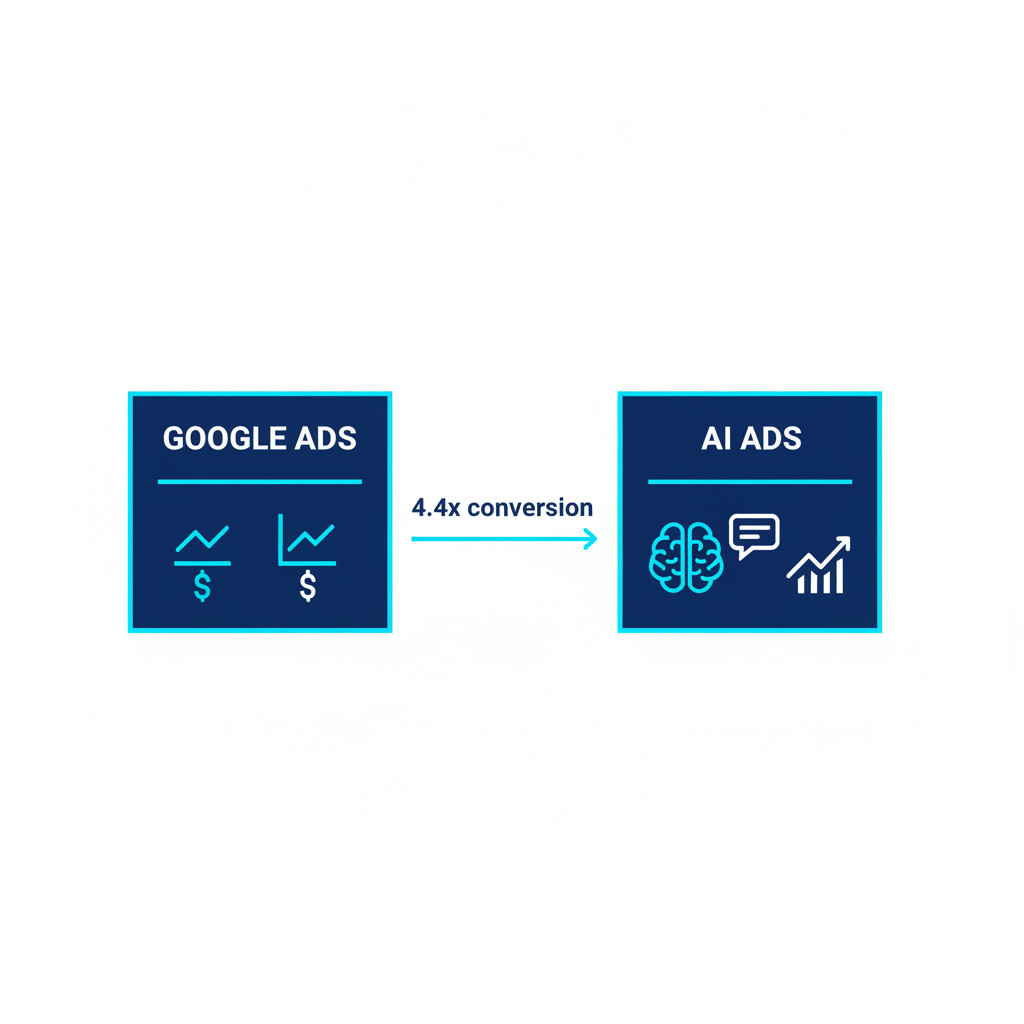
The conversion premium is not an accident. It reflects what the channel actually delivers.
The buyer who arrives via AI recommendation has already done the research, evaluated alternatives, and largely decided. The trust transfer happens before the click. LLMs equip the user with all the information needed to make the decision, and then the AI response is presented like personal, word-of-mouth advice. That carries more emotional weight than a list of paid placements with extension links.
The funnel is shorter. The intent is higher. The click is more valuable. And it is also, by design, harder to bid against, because the buyer was not searching for a product category. They were asking a question.
An operator selling brake kits does not get to bid on “brake kit” anymore. They get to be the brand the AI recommends when a buyer says “I want to upgrade braking on my 2022 F-150 Lightning for towing.” Whether that recommendation lands on your store is a different problem than whether your Google Ads campaign was set up right.
The fork ahead: monetized vs. subscription AI
The two business models AI companies are now running on do not coexist neatly. They imply different operator strategies.
| Platform | Monetization model | What operators bid on | Where the conversion lives |
|---|---|---|---|
| ChatGPT | Paid ads (Feb 2026 launch); $60 CPM | Placement inside answer cards and product mentions | 15.9% conversion (Semrush) |
| Google AI Mode / Overviews | Performance Max + Search campaigns transfer in | Existing keyword strategy with AI-overview eligibility | Significantly above 1.76% Google Organic |
| Claude | Premium subscription; no ads | Earned recommendations via content quality and citation signals | Organic referrals; harder to attribute |
| Perplexity | Premium subscription; no ads | Content recency, stat density, structured data | Citation-driven; 82% of cited pages are under 30 days old |
For automotive operators, the right read is that AI is not one channel. It is two: a paid channel (ChatGPT, Google AI Mode) and an earned channel (Claude, Perplexity). Each requires different muscles. The paid channel rewards bid management and creative discipline. The earned channel rewards AI-ready product search, structured catalog data, and content that LLMs can cite verbatim.
The same store can compete in both. Most operators will end up doing exactly that, splitting AI budget across paid placement and earned-citation content investment, the same way they once split between paid search and organic SEO.
Where the budget actually goes
If you are building a 2026 media plan, the line items have moved. Three new categories operators are now budgeting against:
- AI placement CPMs. $60 CPM is the starting point for ChatGPT, not a ceiling. As demand-side competition picks up over the next quarters, expect the effective cost per qualified click to track closer to high-intent Google Shopping CPCs than to display CPMs. Allocate accordingly.
- Catalog data investment. AI traffic only converts when the store can handle agent transactions. Structured product data, queryable fitment, and transaction-readiness are now ad-budget concerns, not engineering side projects. The CPC will land on a product page that either converts or does not, and the conversion math is a function of platform architecture.
- Content investment shifts toward citation, not ranking. Earned AI traffic comes from being the page LLMs cite when a buyer asks a question. That favors content with high stat density, named sources, recency, and clean structured data, not the SEO playbook that won 2021.
What this means for operators on legacy platforms
The blunt version: AI-ready commerce is now an ad-budget question, not just an architecture question. If your store cannot complete an agent-initiated transaction, the AI placement CPM is wasted spend. The bid lands. The click comes. The cart fails. The recommendation reverses to a competitor whose store can finish the sale.
This is the structural condition that separates operators who win the channel from operators who pay for it without capturing it.
A useful pattern we see
Operators who win the AI-paid-channel transition are usually not the ones with the largest 2026 ad budget. They are the ones who already invested in the foundation (structured catalog data, native fitment, queryable cart state, AI-aware merchandising) before the channel needed it. The platform-level decisions that look operational today turn into channel-level advantages the moment AI starts routing buyers and pricing the placement.
The CPC math gets worse for everyone. The conversion math gets better only for the operators whose stores can transact.
For aftermarket operators specifically, this is the question worth asking your platform vendor: what does the next six months of AI-channel acquisition cost when the store cannot finish the sale? If the answer is “we are watching the space,” the math is already against you. AI for aftermarket commerce rewards operators whose platform was built for it.
Related reading in the AI commerce cluster
- AI-Ready Commerce for Complex eCommerce: the foundational hub explaining what AI readiness means operationally for complex catalogs
- AI Agents Are Shopping for Your Customers. Can Your Store Take Their Money? Why most platforms structurally cannot complete agent-initiated transactions
- AI Doesn’t Fix Bad Catalog Data. It Amplifies It. Why structured product data and ACES/PIES discipline determine AI commerce success
- API-First Was a Nice-to-Have. The Agent Era Makes It Table Stakes. What open API architecture actually means for agent-transactable commerce
Get more from Web Shop Manager in Google Search:



Get in touch with us
Reach out to us for any inquiries or support, and let’s connect!


More On Related Topic
Explore our highlighted blogs for the latest insights and trends in the industry.
WSM 6.0: A New Foundation for Modern Automotive Ecommerce
What Automotive Ecommerce Demands TodayAutomotive eCommerce is fundamentally different from general retail. Product data is complex. Fitment matters. Integrations run deep. And performance is not optional.These demands are most acute for:Automotive manufacturers and distributors...
3 Methods to Improve Site Speed and Gets Customers Through Checkout Faster
The benefits of having a quick website are endless, and customers don't put a second thought into leaving one site because it's slow, and moving down the full list of other options to find...
Utilizing SEO: Definitions and Fundamentals of Search Engine Optimization (Part 1)
SEO Definitions | Web Shop ManagerSEO Definitions: Meta Information & KeywordsWhen planning to do SEO (Search Engine Optimization) for your site, it is important to note that there are some basic SEO techniques to...

Ready To Grow Your Business?
Ready to grow your aftermarket eCommerce presence and lift conversions across auto, truck, powersports, marine, and more? Connect with
Web Shop Manager for tailored solutions: strategy, platform, and performance in one team.