May 27, 2026 | 9 Min Read
AI Doesn’t Fix Bad Catalog Data. It Amplifies It.
What a catalog operations lead told us this quarter: “We turned on AI search and our return rate went up. The model was confidently recommending parts that didn’t fit, because the fitment data underneath was 80% accurate at the SKU level and 60% accurate at the qualifier level. The AI didn’t know which 40% to distrust.”
The premise that “AI changes everything” is half true. The other half is that AI mostly amplifies what is already there.
For automotive ecommerce operators, what is already there is a catalog. ACES and PIES data. Fitment relationships. Kit definitions. Supplier feeds with varying quality. Year/make/model coverage at varying depths. If that data is clean and structured, AI makes the store dramatically better. If it is not, AI makes the gaps visible to customers faster than the catalog team can fix them.
AI tends to amplify confusion instead of improving outcomes.
What “AI-ready data” actually means
The phrase gets used loosely. In practice, it has a specific operational definition. Catalog data is AI-ready when an agent can answer four questions reliably without guessing:
- Will this part fit this vehicle? Year, make, model, and qualifier-level compatibility exposed as queryable relationships, not buried in a search filter.
- What is the difference between these two similar SKUs? Attribute normalization at the level where the distinction actually matters (engine code, bed length, trim level, manufacturer tier).
- If this kit is recommended, does every component fit? Per-component fitment validation on bundles, not a flat product grouping that surfaces a bundle when one part fits.
- Is this product available, priced, and accurate right now? Live inventory and pricing exposed through the same data structure the AI used to recommend it.
Most ecommerce platforms can answer one or two of those. AI-ready commerce requires answering all four, in the same query, fast enough that the agent does not have to compose a recommendation from partial signals.
The platforms that cannot answer all four end up with AI experiences that look impressive in demos and produce wrong-fit returns at scale.
The ACES/PIES drift problem
Automotive aftermarket runs on ACES and PIES for a reason. The standards encode the relationships AI needs to navigate fitment correctly: vehicle taxonomy, part attributes, configuration validity, supersession logic. When ACES/PIES is current and complete, the agent has a structured graph to traverse. When it is not, the agent has a partial graph and fills in the gaps with statistical guessing, which is exactly what produces a confidently wrong recommendation.
The honest reality of ACES/PIES in production is that it drifts. Suppliers update mappings on different cadences. Vehicle taxonomy changes annually. Cross-references age out. Manual reconciliation is where catalog labor disappears, and the cost compounds at scale. A 100K SKU catalog with 200+ suppliers cannot be reconciled by hand on a weekly cycle.
This is the operational condition that makes AI fitment guidance a platform problem, not a search problem. The fitness of the AI is downstream of the fitness of the data, and the data fitness is downstream of how the platform handles supplier feeds.
What changes when AI is reading structured data
The lift from AI on a clean structured catalog is not incremental. It is the difference between an agent making a confident correct recommendation and an agent declining to recommend. The former captures the sale. The latter sends the buyer back to a competitor.
Specifically, what changes:
- Search precision improves where it matters most. PartsLogic Smart Search prompts for the qualifier that determines fitment (trim, engine, bed length, doors) before checkout. The agent reads the qualifier prompt as structured input and answers it accurately on behalf of the buyer.
- Kit recommendations stop producing wrong-fit returns. A bundle that surfaces only for vehicles where every component fits is dramatically more useful to an agent than a bundle that surfaces broadly with per-component fitment errors discovered at install.
- Cross-sells become application-aware. An agent that knows the buyer’s vehicle and the catalog’s compatibility graph can recommend related parts that actually pair with the primary purchase, not generic “customers also bought” signals.
- Catalog content scales without quality collapse. AI catalog enrichment works because the AI has clean attribute structure to enrich against. The enrichment is anchored, not invented.
The platform answer
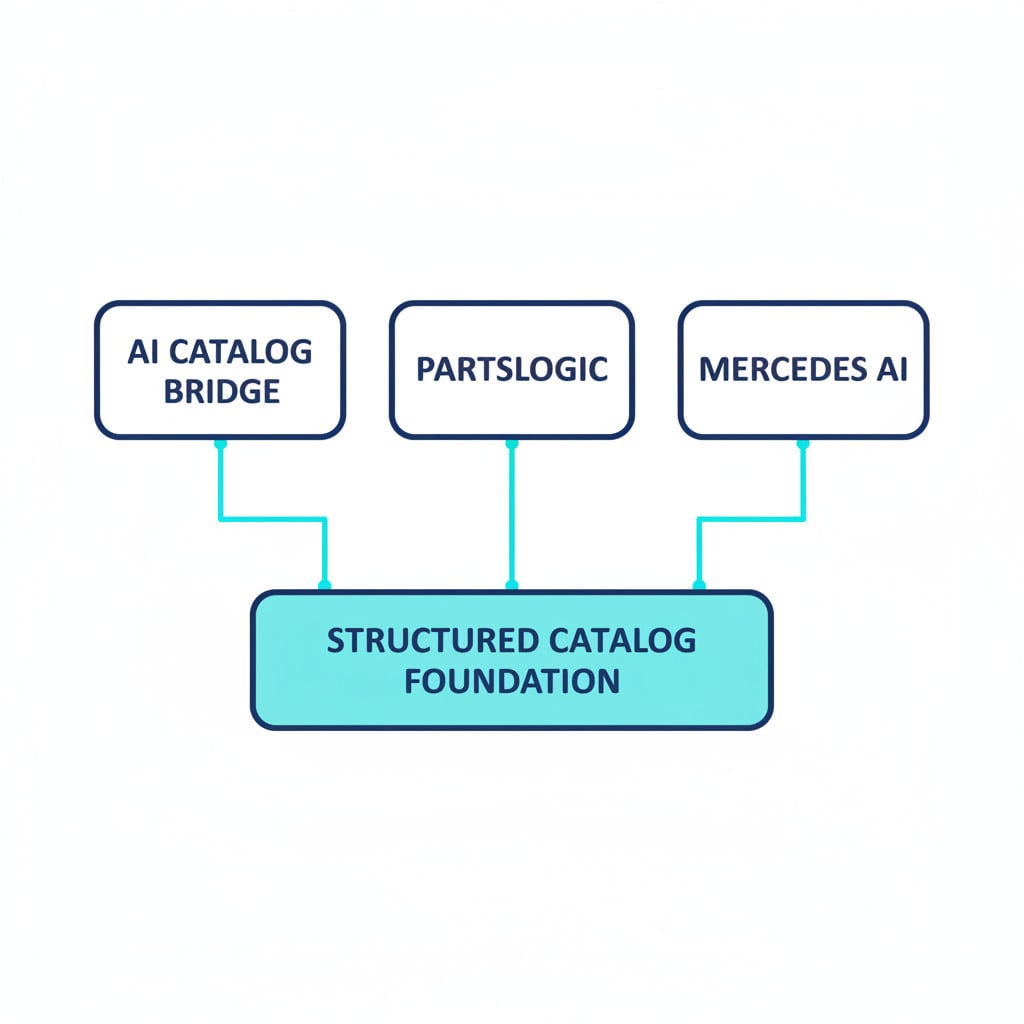
WSM 6.0 was rebuilt around the operational condition that AI commerce requires clean structured data, and that clean structured data requires automation at the supplier-feed layer. The platform that powers $400M+ in annual online sales for shops like Fuel Moto, ECGS, and Suncoast handles this through three components that work together:
AI Catalog Bridge. Drop any supplier CSV and the AI auto-maps the columns. Auto-detects PIES and ACES schemas. Runs scheduled FTP/SFTP pulls so supplier feeds stay current without manual intervention. Mappings stick across re-imports, so the catalog team is not redoing the same column-mapping work every quarter. Onboarding a new supplier feed drops from hours per feed to minutes.
PartsLogic Smart Search. The search layer assumes structured fitment data underneath, and uses it. Qualifier prompts surface before the buyer reaches checkout, so the fitment decision is made at the point where the customer can still change it. For AI agents, the qualifier prompt is a structured input the agent answers from the buyer’s context, not an obstacle the agent has to interpret as an HTML form.
Mercedes AI. Mercedes ships today for catalog work and is expanding into fitment Q&A, customer support, and merchandising on the same structured-data foundation. The same data that powers Mercedes powers the agent-facing experience, which means an AI agent talking to your store gets the same fitment intelligence the catalog team gets.
This is not three features bolted onto a generic ecommerce platform. It is what data services and standards work looks like when the platform was built for structured complexity from day one.
The data discipline checklist
If you are evaluating whether your catalog is AI-ready, the audit below is what a serious AI deployment will surface within the first 90 days of production.
| Data discipline | What “AI-ready” looks like | What AI will do if it’s missing |
|---|---|---|
| ACES/PIES sync cadence | Automated nightly sync; supplier-feed drift surfaces in days, not quarters | Confidently recommends parts that fit last year’s vehicle taxonomy |
| Qualifier-level fitment depth | Engine, trim, bed length, doors, exposed as structured catalog data, prompted before checkout | Recommends fitment by year/make/model only; misses qualifier-level mismatch |
| Kit / bundle fitment validation | Per-component validation; bundle surfaces only when every part fits | Recommends bundles where one component is wrong; install-time return |
| Attribute normalization | Standardized values across suppliers; distinct attribute schemas merged sensibly | Confused on look-alike SKUs; recommends the wrong tier or material |
| Inventory and pricing freshness | Live inventory + pricing exposed in the same query path as fitment | Recommends out-of-stock parts; buyer abandons after click-through |
| Supersession logic | Discontinued parts mapped to their replacements; AI follows the chain | Recommends discontinued SKUs; ticket lands in customer service |
A useful pattern we see
Operators who get measurable lift from AI are usually not the ones who invested earliest in AI. They are the ones who invested earliest in catalog data discipline: the structured product data, fitment relationships, supplier-feed automation, and qualifier accuracy that AI then has something to work with. When the data is right, AI compounds the investment. When the data is wrong, AI accelerates the customer service load.
The pattern is consistent across the operators we work with: the AI rollout that produces real conversion lift is the one that comes second, after the data layer is in shape. The AI rollout that produces returns and support tickets is the one that comes first, on top of a catalog that was not ready.
This is what AI-ready commerce actually requires, and it is why structured product data is not a behind-the-scenes catalog problem anymore. It is the moat.
Related reading in the AI commerce cluster
- AI-Ready Commerce for Complex eCommerce: the foundational hub explaining what AI readiness means operationally for complex catalogs
- AI Agents Are Shopping for Your Customers. Can Your Store Take Their Money? Why most platforms structurally cannot complete agent-initiated transactions
- The CPC Math Just Changed: AI Is a Paid Acquisition Channel Now: what OpenAI’s $60 CPM launch means for 2026 ad budgets
- API-First Was a Nice-to-Have. The Agent Era Makes It Table Stakes. What open API architecture actually means for agent-transactable commerce
Get more from Web Shop Manager in Google Search:



Get in touch with us
Reach out to us for any inquiries or support, and let’s connect!


More On Related Topic
Explore our highlighted blogs for the latest insights and trends in the industry.
WSM 6.0: A New Foundation for Modern Automotive Ecommerce
What Automotive Ecommerce Demands TodayAutomotive eCommerce is fundamentally different from general retail. Product data is complex. Fitment matters. Integrations run deep. And performance is not optional.These demands are most acute for:Automotive manufacturers and distributors...
Customer Acquisition Plan: Are you on the right path to gain more clients?
Whether your brand is already out there and you want to launch a new product or service, or you’re a startup ready to make your first dollar, a customer acquisition plan is a must.After...
2 Proven Management Strategies to Gain More Customers
E-Commerce Management: Online Marketing StrategiesManaging an E-commerce website is no easy feat, and with it comes an abundance of trial and error.And sometimes when we go searching for management strategies we're bombarded by long lists of...

Ready To Grow Your Business?
Ready to grow your aftermarket eCommerce presence and lift conversions across auto, truck, powersports, marine, and more? Connect with
Web Shop Manager for tailored solutions: strategy, platform, and performance in one team.