May 27, 2026 | 10 Min Read
AI Agents Are Shopping for Your Customers. Can Your Store Take Their Money?
What we’re seeing this quarter: An automotive operator gets a customer service ticket asking about a part the customer never actually bought. The customer used ChatGPT to find the part, asked the agent to add it to cart, and assumed the order went through. It did not. The agent hit a JavaScript-rendered cart, could not authenticate the session, and failed silently. The customer waited three days before asking support where their order was. By then, the AI had already recommended a different brand to the next buyer who asked the same question.
AI agents can browse any ecommerce store. They can read product pages, compare specs, check inventory, and pull pricing. What they cannot do on most platforms is finish the sale.
The buyer who asked an agent to find them a part does not see the failure. The agent quietly reverses its recommendation to a competitor whose store can complete the transaction. The store that lost the sale never knows it lost it.
This is the new shape of AI-ready commerce in 2026, and the structural changes happening this year will compound over the next six months.
AI agents are not the search of the future. For OpenAI and Google users, they are the paid acquisition channel of right now.
The new shape of search
OpenAI launched paid ad placement in ChatGPT in February. The price is $60 CPM, and the company is targeting $2.5 billion in advertising revenue for 2026. Google is already running ads inside AI Mode and AI Overviews, sold through Performance Max and Search campaigns. Their CBO told investors in Q1 that the AI Mode ad format “would transfer successfully” to the standalone Gemini app when the time comes.
Anthropic and Perplexity went the other way. Both publicly refused ads, betting on premium subscription. That is a real fork. The two biggest consumer AI surfaces are monetizing through paid placement. The smaller players are not.
For automotive operators, what matters is the math. AI search traffic converts at 4.4 times the rate of traditional organic search (Semrush, 2025). The buyer who arrives via AI recommendation has already done the research, evaluated alternatives, and largely decided. The trust transfer happens before the click. Shorter funnel. Higher intent. More valuable click.
By the time AI recommends a product, the buyer is ready to buy.
Where most platforms break
Here is the structural problem.
An AI agent acting on behalf of a shopper can browse any ecommerce store. Read product pages. Compare specs. Pull pricing. Check inventory. That part works because it is just retrieval.
What does not work is checkout.
Most ecommerce platforms were architected around a human browser session. They expect a logged-in user, persistent cookies, JavaScript-rendered cart state, redirect-based payment flows, and form-based shipping selection. An AI agent does not have any of that. It cannot maintain a session the way a human can. It cannot navigate a CAPTCHA. It cannot complete a Stripe redirect that opens in a new tab. It cannot click “I agree to terms” because the agent does not have legal standing to agree.
This is not a feature gap. It is a structural condition of how the platform was built.
When an agent recommends a store and cannot complete the purchase there, two things happen at once. The buyer reverses to a different recommendation. And the AI learns. The store gets recommended less the next time. The downward spiral compounds quickly because AI ranking systems treat completed transactions as positive signal and incomplete ones as negative signal. Every failed attempt is a vote against the store’s future visibility.
Why automotive is harder
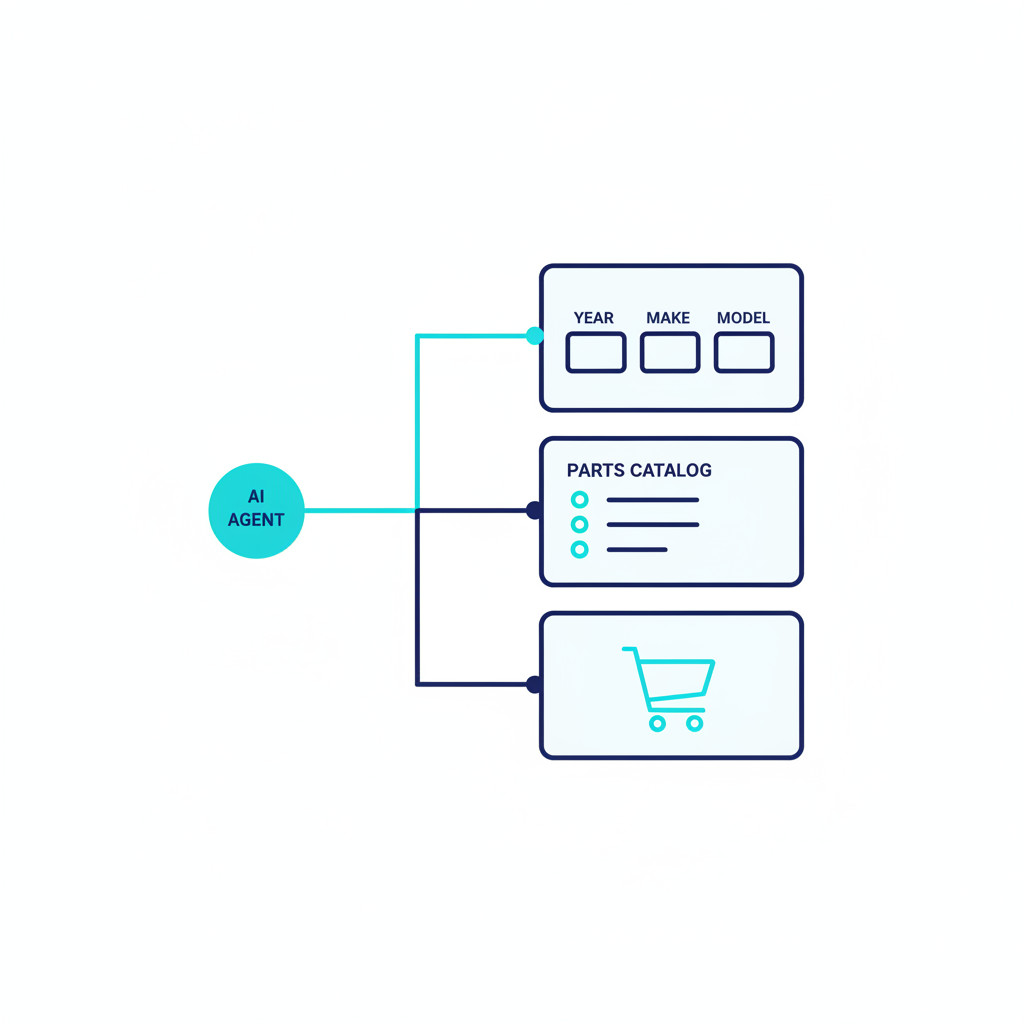
Generic ecommerce is already hard for agents. Automotive is harder.
Automotive buyers shop with three pieces of context that compound every product decision. Year, make, and model. The fitment lookup. The kit or bundle relationship. An AI agent shopping for an automotive part has to navigate all three correctly, then translate the catalog’s representation of those relationships into the cart.
Most generic ecommerce platforms hide fitment behind a search filter, treat kits as flat bundles, and surface part variants through product attribute dropdowns that depend on JavaScript event handlers. An agent does not click dropdowns. An agent reads structured data. If the year, make, and model relationship is not exposed as queryable data, the agent has to guess, and a guess on a fitment-bound part is a wrong recommendation almost every time.
This is why the largest automotive retailers running on generic ecommerce platforms see AI agent traffic abandon at much higher rates than their human traffic. The platforms can render the page. They cannot finish the sale. The deeper issue is the same one operators have always faced with these platforms when catalog complexity hits scale, only now the cost of getting it wrong shows up faster because the AI is watching.
What WSM 6.0 was built for
WSM 6.0 was rebuilt from the ground up to make every part of the buying flow accessible to an agent the same way it is accessible to a human. The platform that powers $400M+ in annual online sales for shops like Fuel Moto, ECGS, and Suncoast was rearchitected around the operational condition that AI-ready commerce actually requires.
Year, make, and model are exposed as structured catalog data, not as a frontend filter. Fitment relationships are queryable, not buried in JavaScript. Kits and bundles are represented as composable units with explicit per-component fitment validation. The cart is a stateful API resource. Checkout completes through a clean, agent-friendly transaction flow that does not require browser cookies, redirect chains, or human-only authentication.
An agent on WSM 6.0 can do everything a human can do. Browse the catalog. Configure a fitment-specific part through PartsLogic. Add a bundle to cart. Apply a coupon. Complete payment. Receive confirmation. End to end. No human in the loop.
This is not a feature we added. It is the foundation we rebuilt on. The same foundation makes agent-assisted buying readiness a deployment decision rather than a multi-year platform rewrite.
Where the divergence shows up
If you are evaluating whether your current platform can support agent-transactable commerce, the differences below are where the gap appears in real operations.
| Capability | Agent-ready (WSM 6.0) | Legacy stacks | What this means at scale |
|---|---|---|---|
| Fitment data exposure | YMM and compatibility relationships exposed as structured catalog data, queryable without JavaScript | Fitment hidden behind a search filter or rendered through client-side JavaScript | Agents either get accurate fitment or guess — and a guess on a fitment-bound part is a wrong recommendation |
| Cart state | Stateful API resource; agents read and modify the cart programmatically | Browser-session cart with JavaScript event handlers and persistent cookies | Most agents fail at “add to cart” before they reach payment |
| Checkout flow | Single agent-friendly transaction flow; no popups, no redirects to external tabs | Multi-step redirects, Stripe popups, CAPTCHA, “I agree” checkboxes | Agents cannot authenticate or accept terms; transaction silently fails |
| Kit and bundle resolution | Per-component fitment validation; a bundle only surfaces for vehicles where every part fits | Bundles treated as flat product groupings; per-component fitment depends on configuration | Wrong-fit returns spike on kit purchases — one component mismatch ruins the order |
| Transaction observability | Agent-initiated transactions are tracked as their own channel; AI traffic is observable | Agent traffic indistinguishable from broken browser sessions in analytics | Operators cannot measure what they cannot see; budget allocation suffers |
Three questions to ask about your store this week
If you are running anywhere other than WSM 6.0, the next six months will test whether your platform can capture the channel that is actually coming. Three diagnostic questions you can answer before Friday:
- Can an AI agent retrieve your fitment data without rendering JavaScript? Open a terminal. Curl your product page. If the year, make, and model relationships are not in the raw HTML or in a queryable API endpoint, agents are guessing.
- Can an AI agent complete checkout without a browser session? Test it. Tools like Anthropic’s Computer Use and OpenAI’s Operator are publicly available. Point one at a known SKU on your store. See if it can get through to a confirmation page. Most stores fail at the cart or payment step.
- Is your AI traffic distinguishable from your human traffic in analytics? If not, you cannot tell which channel is converting, which means you cannot budget for it. Agent-aware platforms tag agent transactions as their own channel.
A useful pattern we see
Operators who win the agent-transactable channel are usually not the ones with the biggest catalog or the most ad spend. They are the ones whose AI-ready commerce foundation was built before the channel existed. The platform-level decisions that look operational today — structured fitment data, queryable cart state, programmatic checkout — turn into channel-level advantages the moment AI starts routing buyers.
Whoever is spending $2 CPCs on automotive intent searches today should expect multiples of that for AI placement within twelve months. The CPC math gets worse for everyone. The conversion math gets better only for the operators whose stores can transact.
If you want to see what an agent-transactable storefront actually looks like running on real fitment data, we can show you yours.
Related reading in the AI commerce cluster
- AI-Ready Commerce for Complex eCommerce — the foundational hub explaining what AI readiness means operationally for complex catalogs
- The CPC Math Just Changed: AI Is a Paid Acquisition Channel Now — what OpenAI’s $60 CPM launch means for 2026 ad budgets
- AI Doesn’t Fix Bad Catalog Data. It Amplifies It. — why structured product data and ACES/PIES discipline determine AI commerce success
- API-First Was a Nice-to-Have. The Agent Era Makes It Table Stakes. — what open API architecture actually means for agent-transactable commerce
Get more from Web Shop Manager in Google Search:



Get in touch with us
Reach out to us for any inquiries or support, and let’s connect!


More On Related Topic
Explore our highlighted blogs for the latest insights and trends in the industry.
5 Tips for DIY SEO: Search Engine Optimization on a Budget
Web Shop Manager - DIY SEO & Cost Effective SEOSearch engine optimization (SEO) can mean the difference between getting found on Google and getting lost in the vast information landscape of the internet. If...
Successful Ways to Reward Customers and Gain Loyal Shoppers
Customer Retention: Successful Ways to Reward Customers and Gain Loyal ShoppersWhen running an online business, it's critical that your customers are loyal. You don't want their business once – you want it over and...
Customer Acquisition Plan: Are you on the right path to gain more clients?
Whether your brand is already out there and you want to launch a new product or service, or you’re a startup ready to make your first dollar, a customer acquisition plan is a must.After...

Ready To Grow Your Business?
Ready to grow your aftermarket eCommerce presence and lift conversions across auto, truck, powersports, marine, and more? Connect with
Web Shop Manager for tailored solutions: strategy, platform, and performance in one team.