Nov 14, 2026 | 6 Min Read | By Dana Nevins
Kit vs Bundle in Auto Parts Ecommerce: The Difference That Changes Your Pricing
A kit is a locked package the seller defines: separate parts you stock, sold at one fixed price. A bundle is built by the shopper on your site from stocked parts, and the shopper can change it before checkout.
The two words get used for the same thing in most parts stores. A shopper sees "Front and Rear Floor Liner Set" and the owner calls it a kit. Another shopper picks a lift, a shock and a track bar on a build page and the owner calls that a kit too. They are different products with different rules for price, stock, fitment and product pages, and getting the word wrong gets the setup wrong.
One question tells them apart: who decides what is in the box? If the seller does, it is a kit. If the shopper does, it is a bundle. Web Shop Manager does both, and here is what each looks like on a live store.
A kit: the seller locks the package
A kit is one product on your site. It has its own product page, its own price and its own place in the category tree, and the shopper cannot change what is inside. The parts inside are separate items you stock, which is what makes it a kit and not a new part.
Our example is on tonneauoutlaw.com: the WeatherTech FloorLiner DigitalFit Front & Rear Set. It is made of two single liners, a front and a rear, each with its own page and its own price. The set page shows one price, $227.90, and one fitment list for the whole set.
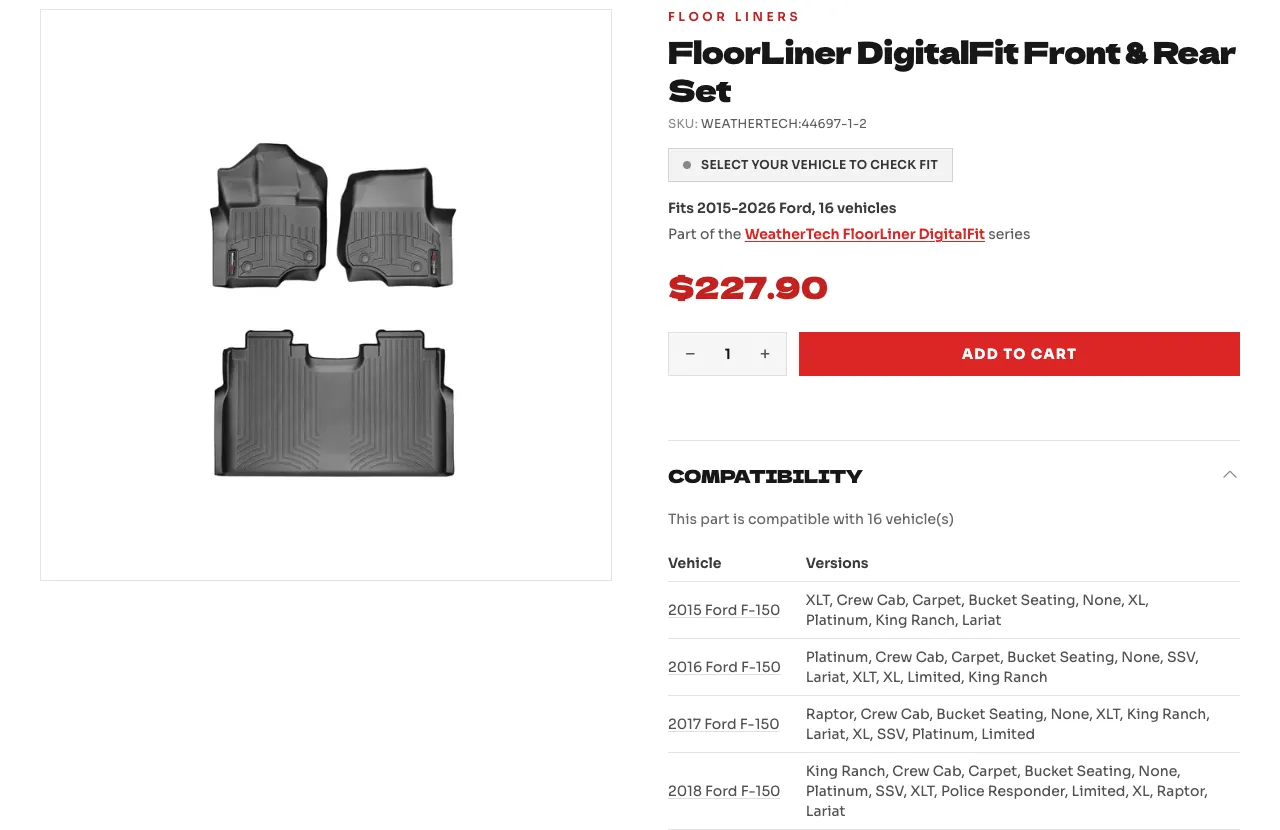
The set price is arithmetic we chose. The front liner is $133.95 and the rear liner is $108.95, both read live on tonneauoutlaw.com on November 14, 2026. Our set price takes $15 off the two:
$133.95 + $108.95 - $15 = $227.90
That $15 is our set price decision for this example. It is not a WeatherTech price list, and we make no claim about any brand's policy. A kit price is a number the seller sets on purpose.
A bundle: the shopper builds the package
A bundle is built on the site by the shopper, from parts you stock, and it can be changed until checkout. It is a build page with steps, not a stocked product with a single price.
Our example is the BDS build-your-own lift page for a 2020 to 2022 Ford F-250 or F-350 Super Duty 4WD, on a demo store. The shopper picks the truck first, then the lift height, front suspension, rear lift and shocks, then optional parts: a steering stabilizer, a track bar and traction bars. The page offers 32 lift builds from 3 to 9 inches, starting at $1,711.60, and the price updates with every pick.
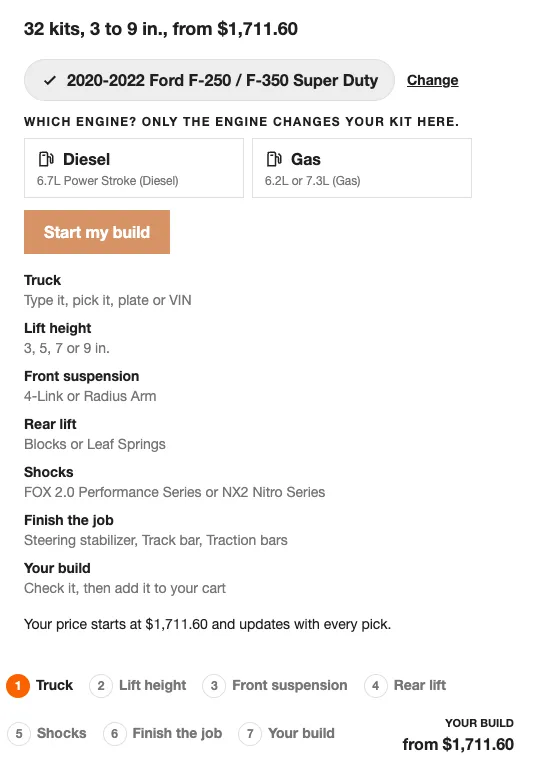
Each part goes into the cart as its own line, grouped under the build. The store sets the rules, such as which track bar goes with which lift, and a discount if it wants one, either a fixed amount or a percent.
Kit vs bundle: pricing, inventory, product page and fitment
| Kit | Bundle | |
|---|---|---|
| Who sets the contents | The seller | The shopper, inside the seller's rules |
| Pricing | One set price the seller chooses | The chosen parts added up, less a discount if the store sets one |
| Inventory | The lowest stock among its parts | Only the parts the shopper picked |
| Product page display | A normal product page with one price | A build page with steps and a running total |
| YMM fitment | Fits only the vehicles every part fits | Each pick is checked against the truck the shopper chose |
| Can the shopper change it | No | Yes, until checkout |
How do you price a kit?
A kit has one price, so you set it once and on purpose. Write down the sum of the minimum advertised prices (MAP) of the parts, the discount you want and the set price that results, as in the example above. A discount below the sum of the MAPs is a pricing decision, so read the brand's written MAP policy before you list the kit. Do not assume it is allowed.
A bundle has no single price to set. The shopper picks the parts, the store adds them up, and a discount, if there is one, comes off the total.
How does stock work for a kit?
A kit has no stock of its own. Its stock is the lowest stock among its parts: 40 fronts and 3 rears make 3 sets. If a supplier gives no stock figure for one part, the kit's stock is unknown, not in stock. Show a kit as buyable only while every part is in stock, or you will take orders you cannot ship.
A bundle is less strict. The shopper picks parts that are in stock, and the build checks those picks.
How does YMM fitment work for a kit or a bundle?
A kit fits only the vehicles that every part inside it fits. If the front liner fits a truck and the rear liner does not, the set does not fit that truck. If two parts share no vehicle, the kit should not exist. One shared vehicle list for the whole kit is the rule, never "fits what the first part fits".
A bundle checks fit pick by pick. That is why the builder asks for the truck first: the shopper types it, picks it, or enters a plate or VIN, and every later choice is checked against that vehicle.
What about a kit the supplier already sells?
Some suppliers publish the kit themselves. WeatherTech sells front and rear mud flap kits under one part number, and retailers list a UPC for the set. It is packed and orderable as a single item. It is still a kit, because the supplier locked it, but the store has nothing to build. If a supplier already publishes the kit, sell that item and do not build a lookalike.
What should a store owner do?
- Decide for each package who picks. If you pick, make it a kit with a set price. If the shopper picks, make it a bundle with rules.
- Check whether the supplier already publishes the kit.
- Price a kit on purpose: sum of the MAPs, the discount, the set price, and the brand's written policy.
- Show kit stock as the lowest stock among its parts.
- Give a kit one fitment list that every part passes.
- Name things the same way everywhere: "set" or "kit" for locked packages, "build your own" or "bundle" for shopper-built ones.
Selling kits or bundles?
Both run on our eCommerce platform, built for automotive eCommerce with year, make and model fitment in mind. If you want kits or a build page on your store, request a demo and we will walk through yours.
Get more from Web Shop Manager in Google Search:


Get in touch with us
Reach out to us for any inquiries or support, and let’s connect!


More On Related Topic
Explore our highlighted blogs for the latest insights and trends in the industry.
The Definitive Guide to Ecommerce Category Trees: Strategy, Build, and Future-Proofing
How to build a high performance Ecommerce category treeAre you confident your Ecommerce store’s category tree is driving as many sales as it should be? Could it be losing you sales?After years of working...
Website Migrations Don't Have to Kill Your SEO
A replatform does not have to cost you search traffic. Soft Lines, Inc. moved softlinesinc.com from WSM 5.0 to WSM 6.0 the week of October 13, 2026, and its clicks from Google held flat...
FAQs
Everything You Need to Know
A kit is locked by the seller: the parts, the quantities and the price are fixed, and the shopper buys it or does not. A bundle is built by the shopper from stocked parts, inside rules the store sets, and can be changed until checkout.
No. A bundle is usually discounted, but only if the store sets a discount. A bundle with no discount is still a bundle.
No. If the contents change, it is a different kit with its own price.
No. A virtual kit is still locked by the seller. It just has no part number or UPC of its own from the supplier, and its parts ship as the separate parts they are.
Write down the sum of the minimum advertised prices, the discount and the resulting set price before you list it, and read the brand's written MAP policy first. Our example set price is $133.95 + $108.95 - $15 = $227.90.
As the lowest stock among its parts. If one part is out, the kit is out, and if a supplier gives no stock for one part, the kit's stock is unknown rather than in stock.
A multipack is several of the same part sold as one. It is its own thing and does not need kit or bundle logic.

Ready To Grow Your Business?
Ready to grow your aftermarket eCommerce presence and lift conversions across auto, truck, powersports, marine, and more? Connect with
Web Shop Manager for tailored solutions: strategy, platform, and performance in one team.